
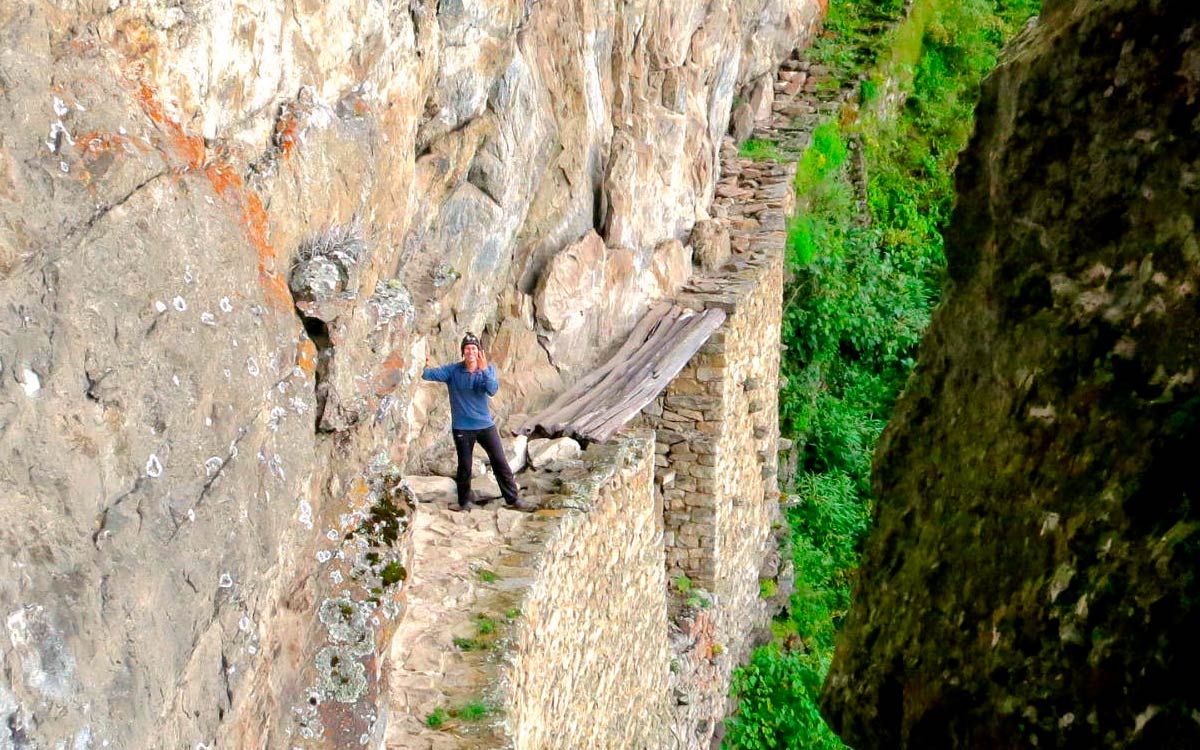
What is the Inca Bridge of Machu Picchu and what sets it apart from the other tours of the sanctuary? Unlike traditional tours, this section was built on the edge of a cliff. The Incas joined the two parts of the cliff using wooden logs, which they could easily remove to cut off the passage if an enemy approached.
The Inca Bridge is inside the Historic Sanctuary of Machu Picchu and is part of the network of trails that connected the citadel with other areas of the empire. It is a lesser-known option than other visits to the site, and its interest lies in how the trail was built on an almost vertical rock wall.
Can it be visited simply by entering the citadel? No. The Inca Bridge requires a ticket that includes this tour and is governed by its own access and security rules, different from those of other circuits. Knowing this before traveling prevents arriving at Machu Picchu and finding out that the ticket does not allow you to do the hike. It also helps decide which day and at what time to go.
In this guide we will see what the Inca Bridge is, its history, and what it was used for. Then we will review the trail route and what you need to know to visit it: ticket, season, schedules, difficulty, and duration. You will also find safety rules, restrictions, and some practical tips, and how it compares to other hikes in Machu Picchu.
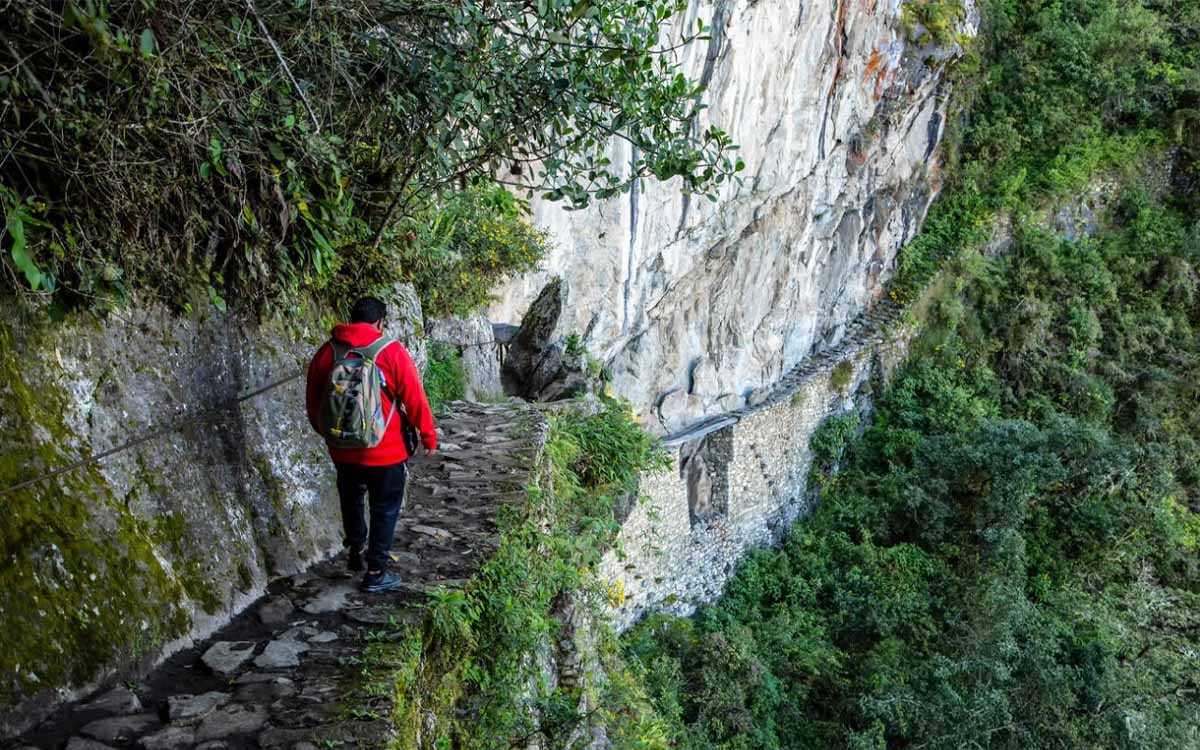
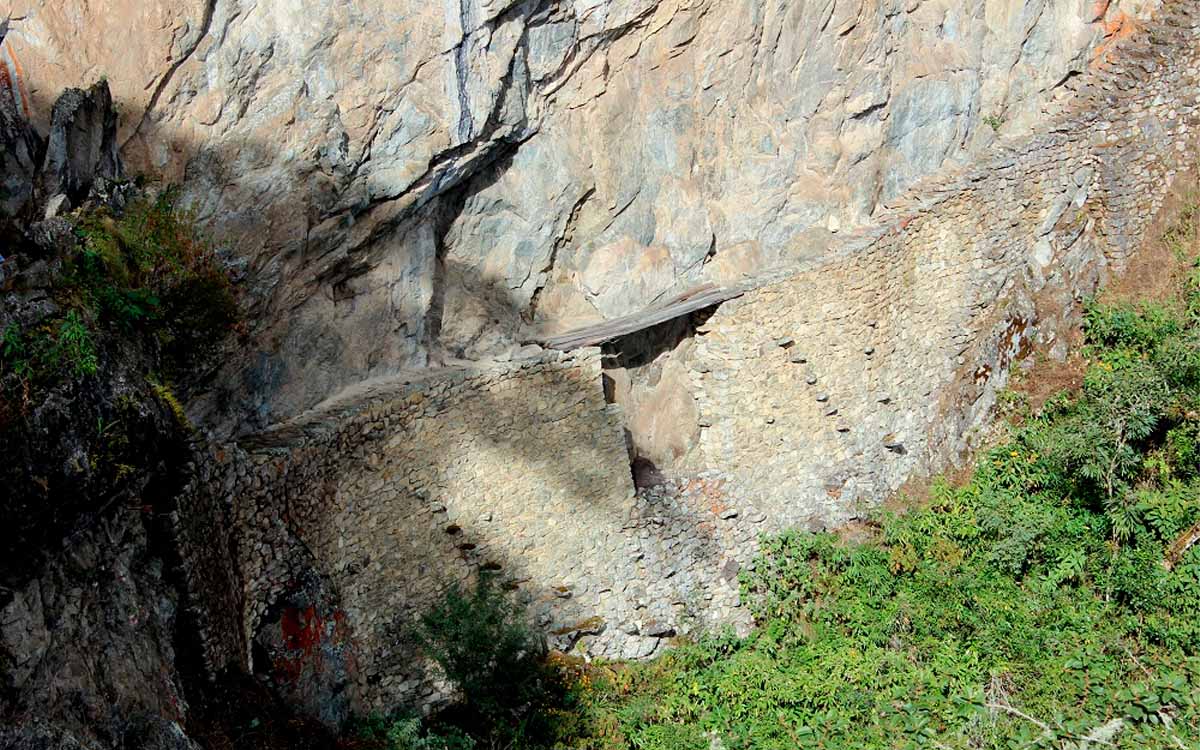
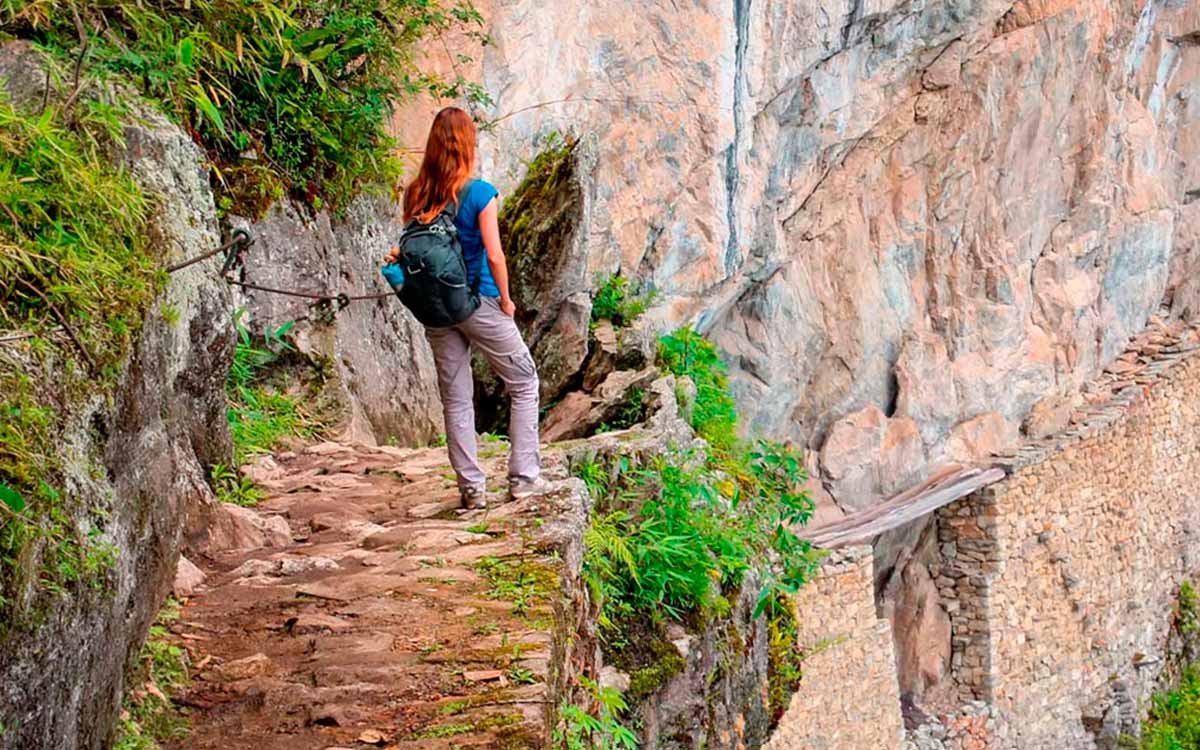
The Inca Bridge is part of the citadel's ancient trail network, a short path that moves alongside an almost vertical rock wall. At one point on the trail there is a gap in the rock that the Incas covered with wooden logs; today this looks like a wooden board laid over a gap of about six meters in the stone path. With the logs in place, you could continue along the slope.
The trail to get there starts from the Guardian's House viewpoint, the classic spot to see the citadel, and is an extension of the same path, so it is walked on the original Inca layout. It is interpreted as a defense of the western entrance of Machu Picchu; therefore its function is not for worship or housing, but for access control.
It is an interesting option within Machu Picchu for several reasons. The hike from the center of the citadel takes about 25 to 30 minutes along a narrow path, with some sections next to the precipice, and is less crowded than Huayna Picchu, Machu Picchu Mountain or the Sun Gate. The path is relatively flat and easy to follow. It lets you see an Inca engineering work in its setting, with the cliff and the mountain in the background.
Machu Picchu was built around 1450 and it is believed to have been a residence of the emperor Pachacuti, although there are no written records from the time to confirm it. Later on, it was abandoned about a century later, probably during the Spanish conquest. Locals knew about the place, but in 1911 the American historian Hiram Bingham made it known internationally. In 1983 UNESCO declared it a World Heritage Site.
The Inca Bridge is inside that sanctuary and is usually associated with the same era, but it does not have its own documented history. The date it was built is not known, nor are there records describing how it was used. Therefore, what follows separates what is observed at the site today from the most accepted interpretations.
The trail to the Inca Bridge is built on the slope, at the western access to Machu Picchu, and moves along a very steep mountain. The materials described are hand-carved stone for the path and wood for the bridge. The last section entering Machu Picchu was restored along with the bridge, and today the gap of about six meters is covered with four or five planks.
Raising a path over a mountain wall was not exclusive to this place. The Qhapaq Ñan, the network of trails that integrated the four regions of the empire, was protected with retaining walls. It is reasonable to place the Inca Bridge within that practice, although details on how this particular section was raised are not given. On the other hand, it is not the same type of bridge as the one at Qeswachaka. That is a suspension bridge made of braided grass fibers, while this is a passage with planks over a gap in the rock. It is described as a simple bridge made to cover a hole.
It is credited with a defense and access control function. If the wooden walkway was removed, anyone coming along that route had to face a much more dangerous approach. That is why it is often called the "secret entrance" to Machu Picchu. Some add that it also served as a route for the chasquis, the Inca messengers.
Visiting the Inca Bridge is not the same as entering the citadel and walking up to it. Since June 2024, Machu Picchu has been operating with defined circuits and routes, and each ticket allows you to travel only the route chosen when purchasing. The Inca Bridge has its own route, so you have to plan it from the purchase, with the date and entry time included. In the following sections you will see what ticket you need, when it is best to go, and how much effort it involves.
Since June 1, 2024, three circuits have been in effect grouping ten routes, and the Inca Bridge is Route 1-D of Circuit 1 (Panoramic), available only in the high season. That is, there is no "general" ticket that later allows you to add the bridge: the route is chosen at purchase and defines where you can walk.
Some guides point out that this route does not allow access to the urban area of the citadel, but it does give access to the two main viewpoints of Machu Picchu. If you also want to tour temples and plazas, you will probably have to combine it with another visit.
| Visitor type | Price (PEN) | Price (USD) |
|---|---|---|
| Adult | S/ 152 | ~$44 |
| University or technical student | S/ 77 | ~$22 |
| Minors from 3 to 17 years old | S/ 70 | ~$20 |
The only official site is the Ministry of Culture portal (tuboleto.cultura.pe). The steps are as follows:
There is also limited in-person ticket sales in Aguas Calientes (Ministry of Culture office, on Pachacútec Avenue), with payment in cash or by credit card. It works for last-minute plans, but it is not a good idea to depend on it in high season.
When should I buy the tickets? Buy as soon as your dates are clear, and before booking trains and hotels. If you travel in July or August, it is a good idea to book one or two months in advance. If you travel at other times during the high season, a few weeks are usually enough, but check availability on the portal.
The Inka Bridge is a high-season route, which coincides with the dry season (roughly from May to October), the most recommended time to hike a trail on the edge of the cliff, with less rain and better visibility. Mornings are cold and afternoons are warmer.
As for schedule, Machu Picchu works with hourly entry time slots, from 6:00 to 15:00, with a 30-minute grace period. Each ticket is for a specific time slot, so it is a good idea to arrive at the gate on time. Book an early time slot: you will have more time to complete the hike and the rest of the visit, and fewer people on the trail.
It is a short hike of low to moderate difficulty. The narrow trail moves along the rock wall, with sections on the edge of the cliff, but the path is relatively flat and easy to follow. What requires attention is the surroundings, not physical fitness: anyone who suffers from vertigo should think twice before doing it.
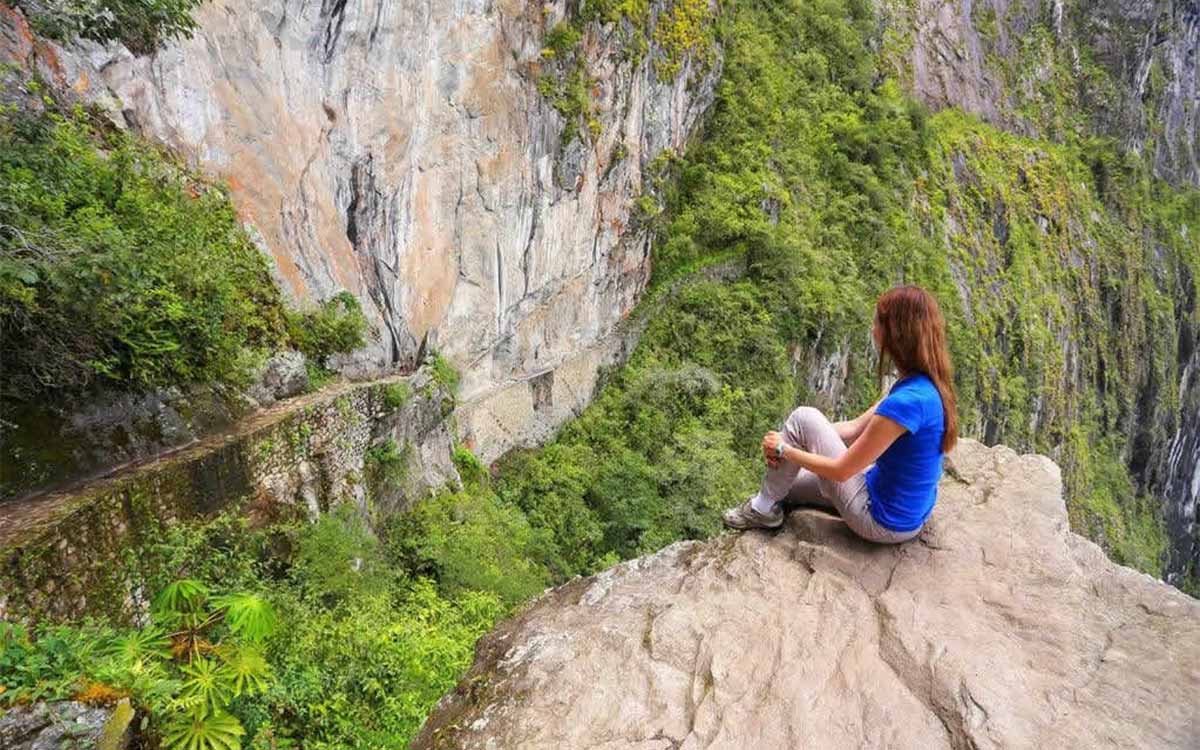
The path to the Inka Bridge is short, calm, and follows the original Inka layout. With ticket 1-D, the visit is reduced to three parts: climbing up to the classic Machu Picchu viewpoint, taking the detour toward the bridge, and returning through the same section. Here is how it works:
The trail begins inside the sanctuary itself, not outside it. From the Machu Picchu entry gate, follow the upper path that climbs through the agricultural terraces to the Guardian's House viewpoint. There is a stone sign pointing left that says "To Inca Bridge, Guardhouse and Sun Gate", and that is the start of the climb.
The section from the Guardian's House to the bridge is an extension of the same trail, so you walk on the original Inka path. A few minutes from the viewpoint is the Inka Bridge control booth, where you must show your ticket and check in. Registration includes your name and entry time for safety reasons, and your exit is also logged. Keep your passport handy.
Depending on how much time you spend on photos at the viewpoint, figure between 30 and 45 minutes from the gate to the start of the trail. The climb up to the Guardian's House is the most demanding part of the entire route.
In total, three visitor and guide accounts agree that the actual section itself (from the booth to the viewpoint and back) takes around 30 to 60 minutes, depending on pace and breaks. If you walk without rushing, set aside an hour for this part.
The trail to the Inca Bridge is short and of low difficulty, but it runs along a cliff and inside a heritage site with strict rules. It is a good idea to know them before going, because breaking them can cost you the visit. According to the rules, anyone who breaks the rules can be kicked out with no refund for the ticket.
The rules of Machu Picchu apply from the entrance gate, so they also hold true on the trail. The most relevant ones for a US visitor are these:
| What is not allowed | Useful detail |
|---|---|
| Large backpacks | Maximum 40 × 35 × 20 cm (about 16 × 14 × 8 inches); anything larger must be left at the checkroom. |
| Tripods, selfie sticks, and stabilizers | Includes extensions for cameras and cell phones. |
| Drones | Prohibited, including overflights, unless officially authorized. |
| Umbrellas and parasols | Use a waterproof jacket or poncho. |
| Trekking poles with metal tips | Only poles with rubber tips are allowed, for elderly people or those with a medical condition. |
| Food and utensils | Sources differ: some allow only light snacks and water. Check the current rule. |
| Aerosol sprays | Bring sunscreen and bug repellent in cream or lotion, not in spray form. It is a detail that surprises many US travelers. |
| High heels and hard-soled shoes | They can damage the floor; wear footwear with a rubber sole. |
| Baby strollers | Not allowed; baby carriers without a metal frame are allowed. |
In addition, climbing, sitting, or leaning on Inca walls and structures, running, shouting, smoking, littering, or lighting fires is not allowed. Feeding vizcachas and birds, and taking unauthorized routes that bypass control, are forbidden.
If you have a guide, their instructions hold just as well: groups answer for their participants.
Machu Picchu offers several hikes with their own ticket, and the Inca Bridge is the shortest and gentlest of all. It does not compete with the others in effort or height, but in what it offers: a quiet trail on an Inca layout, with no summit and no crowds. Here is how it compares to the other three options.
| Feature | Inca Bridge | Huchuy Picchu | Huayna Picchu | Machu Picchu Mountain |
|---|---|---|---|---|
| Altitude | ~2,450 m (8,040 ft) | 2,497 m (8,192 ft) | 2,720 m (8,923 ft) | 3,082 m (~10,110 ft) |
| Duration | 30 to 60 min | 30 to 45 min | 1.5 to 3 h | 2 to 4 h |
| Difficulty | Low to moderate | Low | Moderate to high | Moderate |
| View type | The bridge, the valley, and the classic viewpoint | Elevated and without crowds | The citadel from above | Open panoramic view of the valley |
| Availability | High season only | High season only | All year; limited quota | All year; limited quota |
Huchuy Picchu is the most similar option: short, easy, and high season. The Huchuy Picchu hike takes between 30 and 45 minutes round trip, of low difficulty, and is described as ideal for beginners and families. The difference is in the landscape: Huchuy Picchu is a small mountain with elevated views of the citadel and photos without crowds, while the Inca Bridge is a horizontal trail with a historical structure at the end. If what you want is to see the citadel from above, Huchuy Picchu fulfills that better; if you are interested in engineering and history, the Inca Bridge.
Huayna Picchu is the most famous hike and the toughest. It is a much steeper climb, with narrow steps and very inclined sections at the edge of the cliff, and its difficulty is moderate to high. It offers an elevated and almost aerial view over the citadel. The Inca Bridge is still near the edge, but the path is almost flat. Choose Huayna Picchu if you seek adventure and are in good shape, and the Inca Bridge if you want an effortless walk.
Machu Picchu Mountain is the highest and the longest. Its trail is wider, well-marked, and less steep, but the climb is steady and the altitude is noticeable. The reward is an open panoramic view of the citadel and the valley from further away. It is an excursion of several hours, compared to the hour that the Inca Bridge takes.
Each ticket covers a single route. Mountain hikes have limited spots and sell out first, so book ahead, especially in July and August.

 +51 84 217 551
 +51 997 434 941
 Av Tupac Amaru PP-10B, Santiago, Cusco, Peru
  info@incatrailmachu.com
 www.incatrailmachu.com


