
Machu Picchu is much more than a postcard. Behind the scenic view there are temples, plazas, enclosures and terraces that reveal how the Incas lived, how they organized their society. Every carved stone tells a part of that story, and that is why knowing the attractions of Machu Picchu is the best way to understand the place beyond the photograph.
The Inca citadel, built in the mid-15th century and declared a UNESCO World Heritage Site, is an exceptional example of Inca ingenuity. Its stone walls, drainage systems, and agricultural terraces show an architecture designed to coexist with the landscape. Spaces like the Intihuatana, the Temple of the Sun, or the Sacred Plaza also reflect the deep connection of the Incas with the sky, water, and earth.
In this guide we will tour the main archaeological attractions of Machu Picchu: what they are like, what function they had, and what history they hold. You will also see which ones you can visit today, since the visit is organized into three official circuits that follow a single direction, and each one includes different constructions.
Before touring the attractions of Machu Picchu one by one, it is convenient to understand how the city is distributed; since the Incas did not build it at random, every space has a place and a function. In this way, roughly speaking, the citadel is divided into two large sectors, the agricultural and the urban, separated by a wall and a dry moat. Now we will get to know each of these sectors up close:
It is the most visible part from the entrance, and the one that occupies the slopes toward the east and south of the citadel. Its main attraction is the agricultural terraces, step-like terraces built with stone retaining walls.
The terraces fulfilled several functions at the same time:
This drainage system is one of the reasons why the citadel has withstood centuries of heavy rain. In this sector you will also find structures linked to agricultural work and access control, such as the Guardian's House, from where the classic view of Machu Picchu is obtained.
On the other side of the wall lies the urban sector, with plazas, temples, palaces, residences, and workshops. Most of the constructions visited during the tour are concentrated here.
It is a very varied space, with constructions that are:
The finish of the stone helps to distinguish them. The most important buildings have walls of finely carved and perfectly fitted stone, while simpler constructions use less worked stone.
Within the urban sector, several areas are usually distinguished:
This organization also helps to understand how the attractions of Machu Picchu are located; since the tour for each circuit follows a single direction, which areas you see depends on the route you choose.
Now let's tour the constructions that make Machu Picchu a unique place. These attractions of Machu Picchu bring together the essentials of the citadel: worship spaces, observatories, surveillance, and landscapes. For each one you will see how it is built, what it could have served for, what importance it had, and a detail that you might not have known.
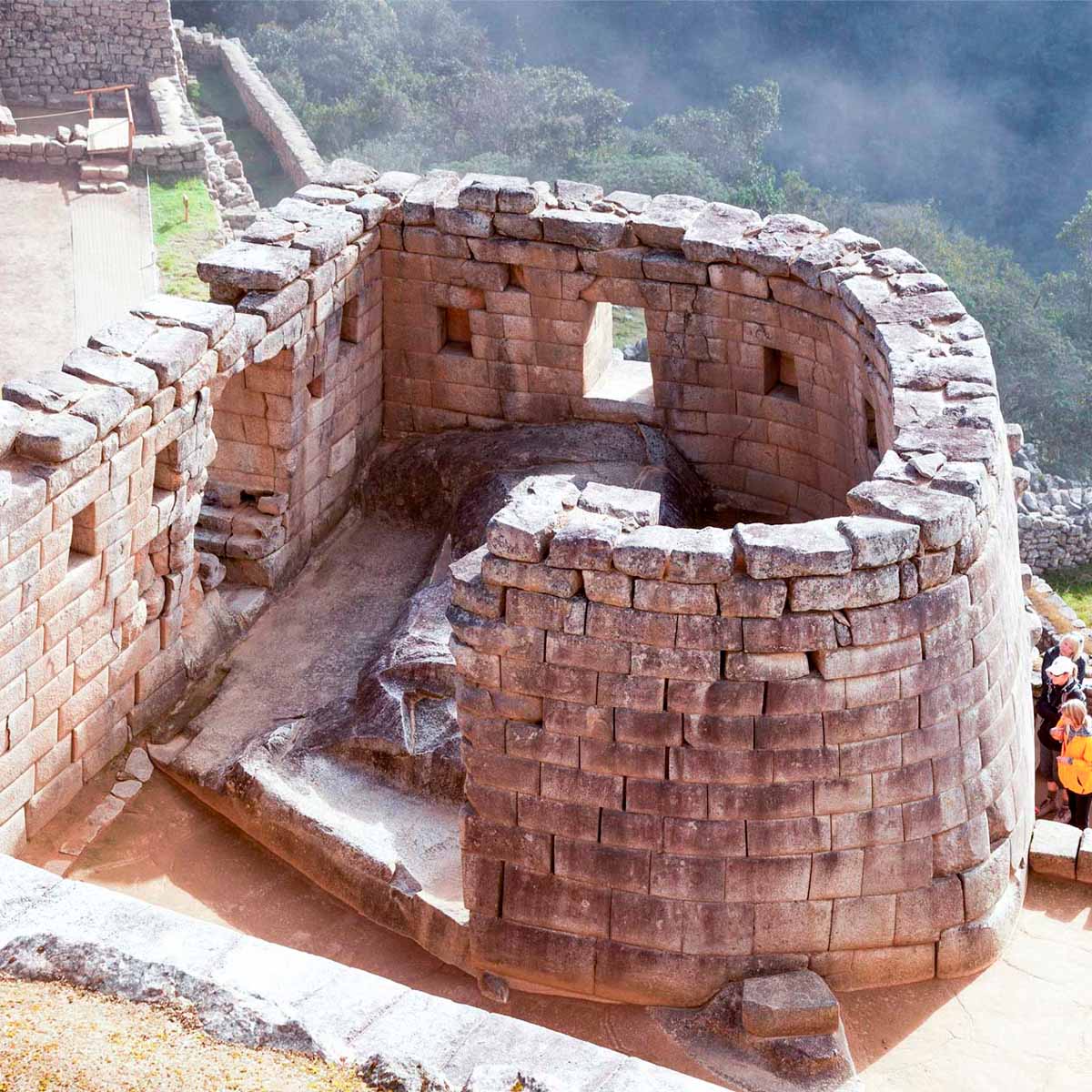
The Temple of the Sun is one of the most refined constructions in the citadel. Its curved, semicircular wall surrounds a large rock that is part of the building itself. The stone is carved with such precision that the blocks fit almost perfectly, a work reserved for the spaces of greatest importance.
Its probable function was ceremonial. The Sun (Inti) held a central place in the Inca religion, and this temple appears to have been designed to observe it. Under the temple opens a natural cave worked with niches and steps, known as the Royal Tomb.
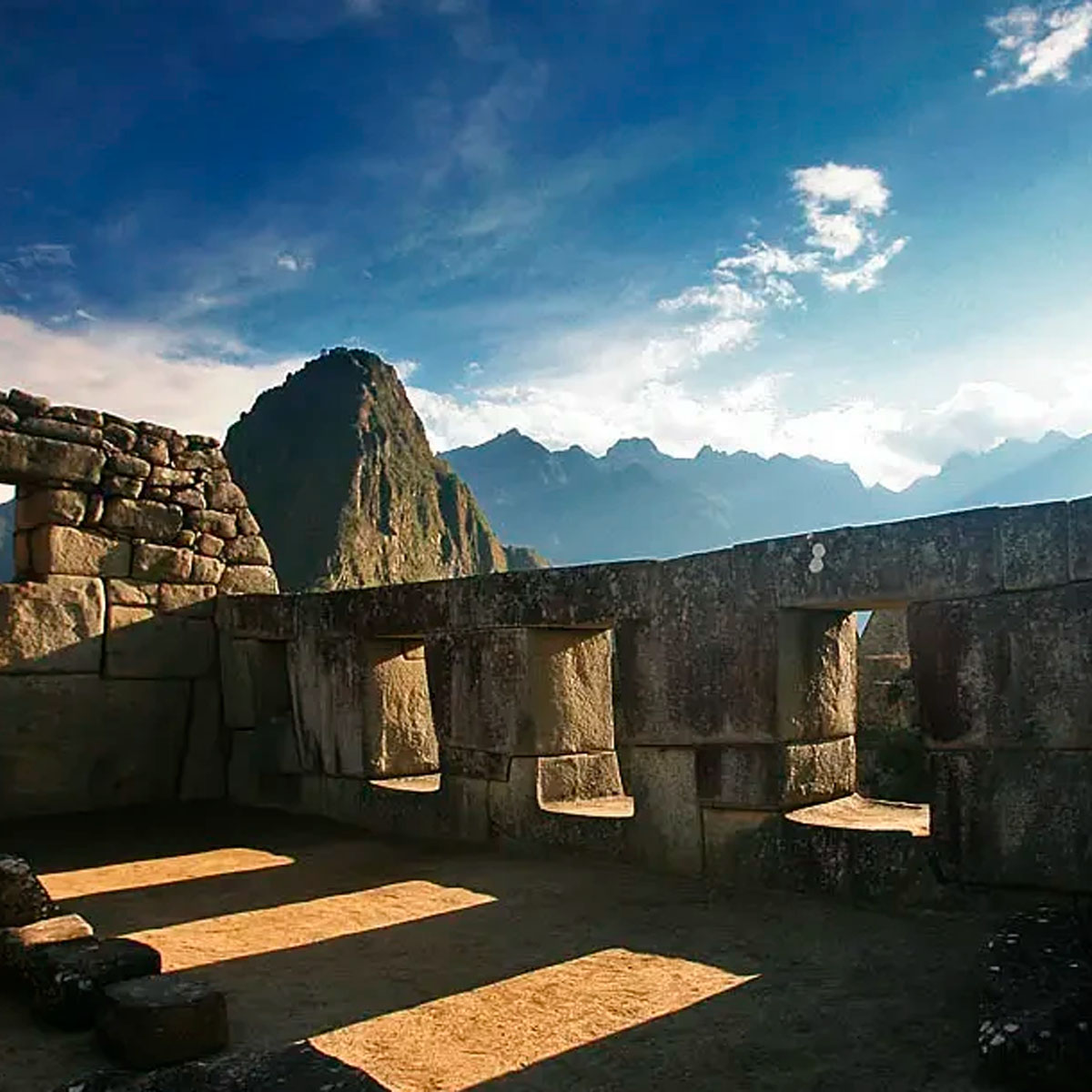
It is located at the eastern end of the Sacred Plaza, facing toward it. Its most famous feature is the three large windows in its wall, made with large, finely polished stone blocks fitted with precision. The trapezoidal shape, wider at the base, is characteristic of Inca architecture and provides stability against earthquakes.
The windows open toward the east, where the sun rises, and frame the landscape. Its religious symbolism is interpreted in several ways. The most famous was proposed by Hiram Bingham, who linked them to the myth of the Inca origin, born from a cave with three windows called Tambo Toco.
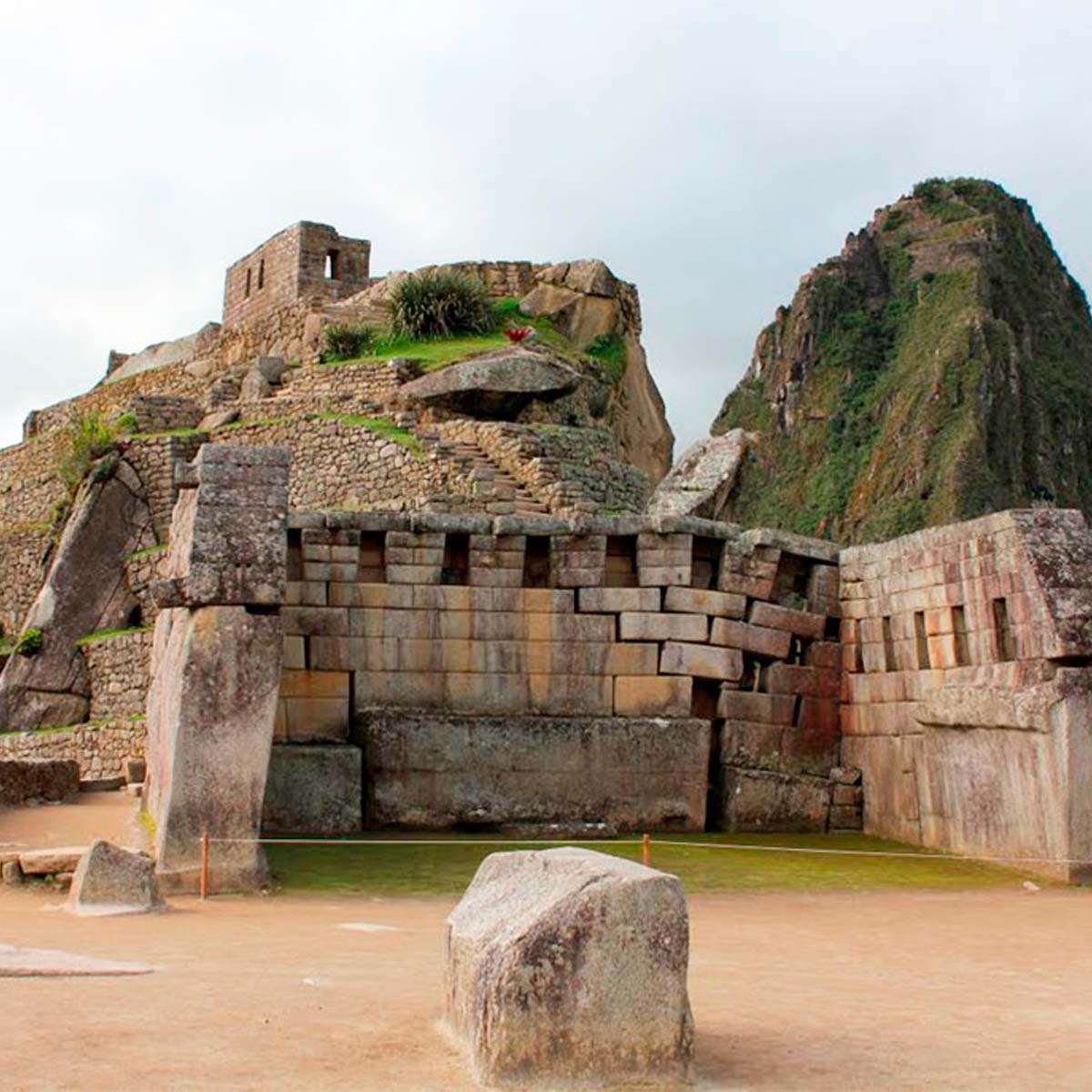
It closes the western side of the Sacred Plaza, opposite the Temple of the Three Windows. This enclosure impresses with its huge stone blocks, carved with care and placed with great precision. It has three walls and its front opens toward the plaza, with niches that could have served to place offerings or ritual objects.
Its function was probably religious and ceremonial, and its size and construction quality suggest that it was a central building of worship. Along with the Temple of the Three Windows and other nearby structures, it forms the Sacred Plaza ensemble, the spiritual heart of the city.
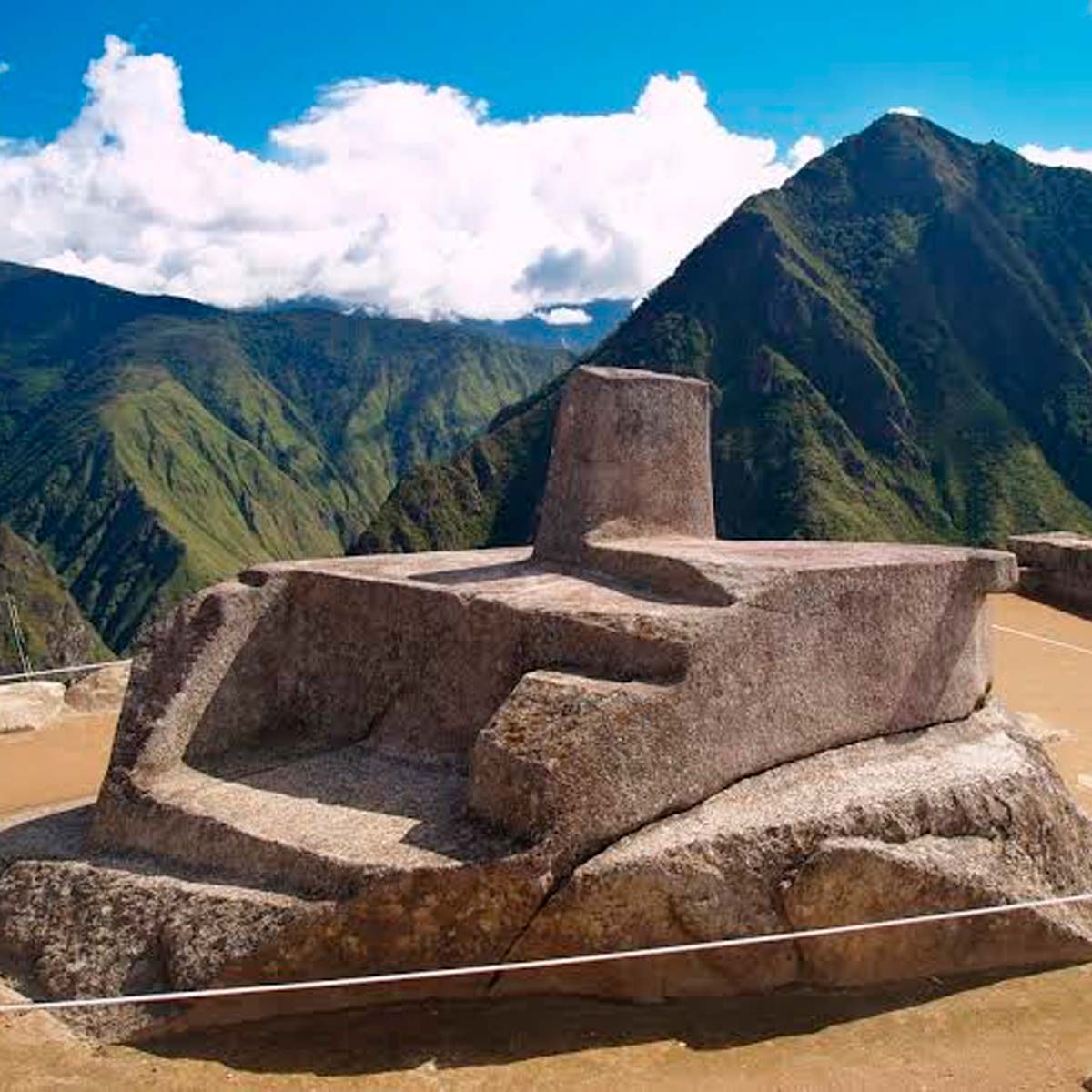
The Intihuatana is one of the most recognized symbols of Machu Picchu. It is a granite block carved from a single piece, rising like a pillar on a platform at the highest part of the sacred sector.
It is believed to have had an astronomical and ceremonial use. It has been described as a sundial or instrument to track the movement of the sun and mark key dates of the agricultural and religious calendar. Some maintain that, near the equinoxes, at noon the pillar projects almost no shadow.
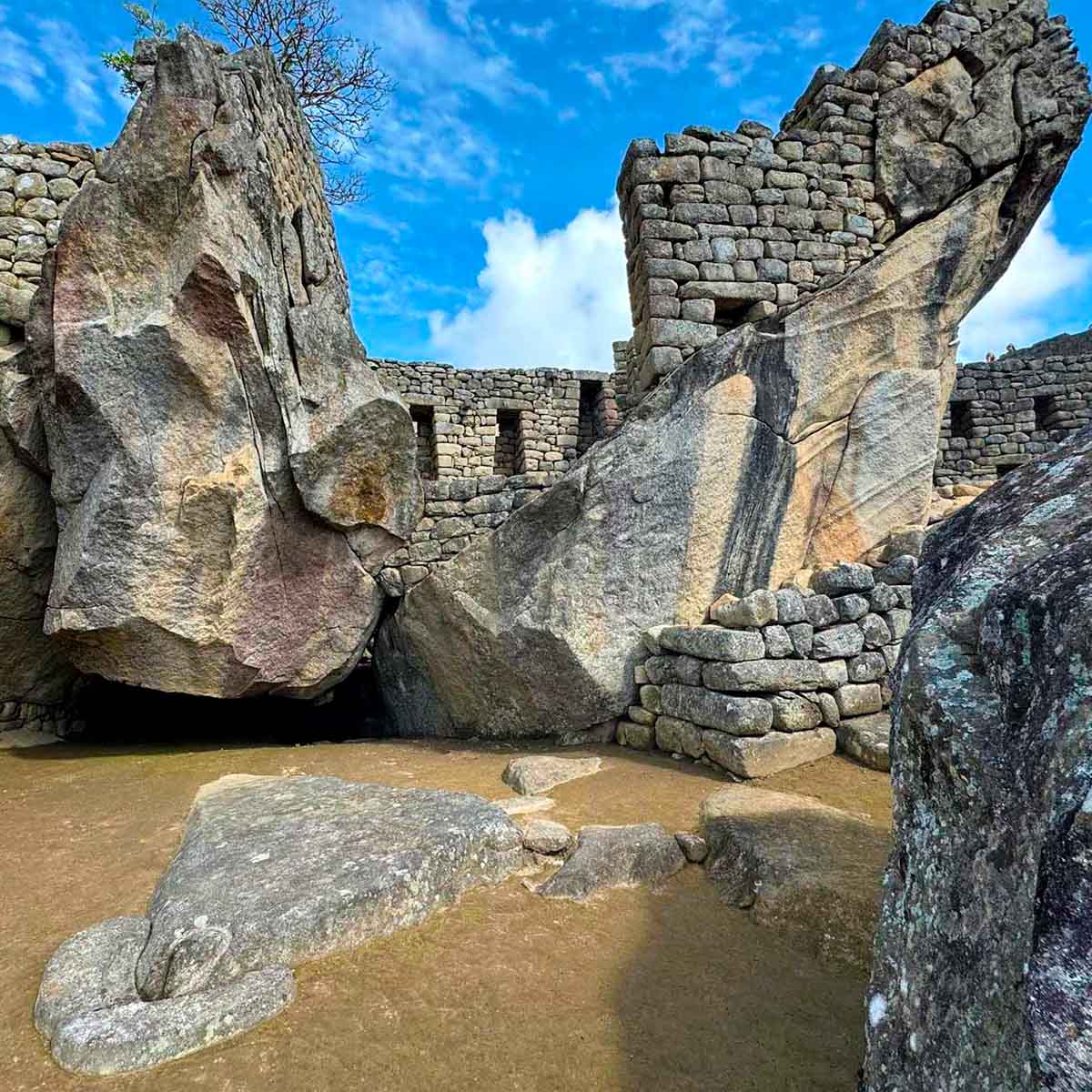
It is located in the lower zone of the citadel. Its distinction is that the shape of the condor is not built: it was achieved using the natural rock. Two large natural stones, open backward, form the wings, while a carved stone on the ground reproduces the head and neck of the bird. The ensemble is completed with finely crafted walls.
The condor occupies an important place in the Andean worldview. It represented the Hanan Pacha, the world above, and was considered a messenger between earth and sky. That is why it is believed that this space had a ceremonial use.
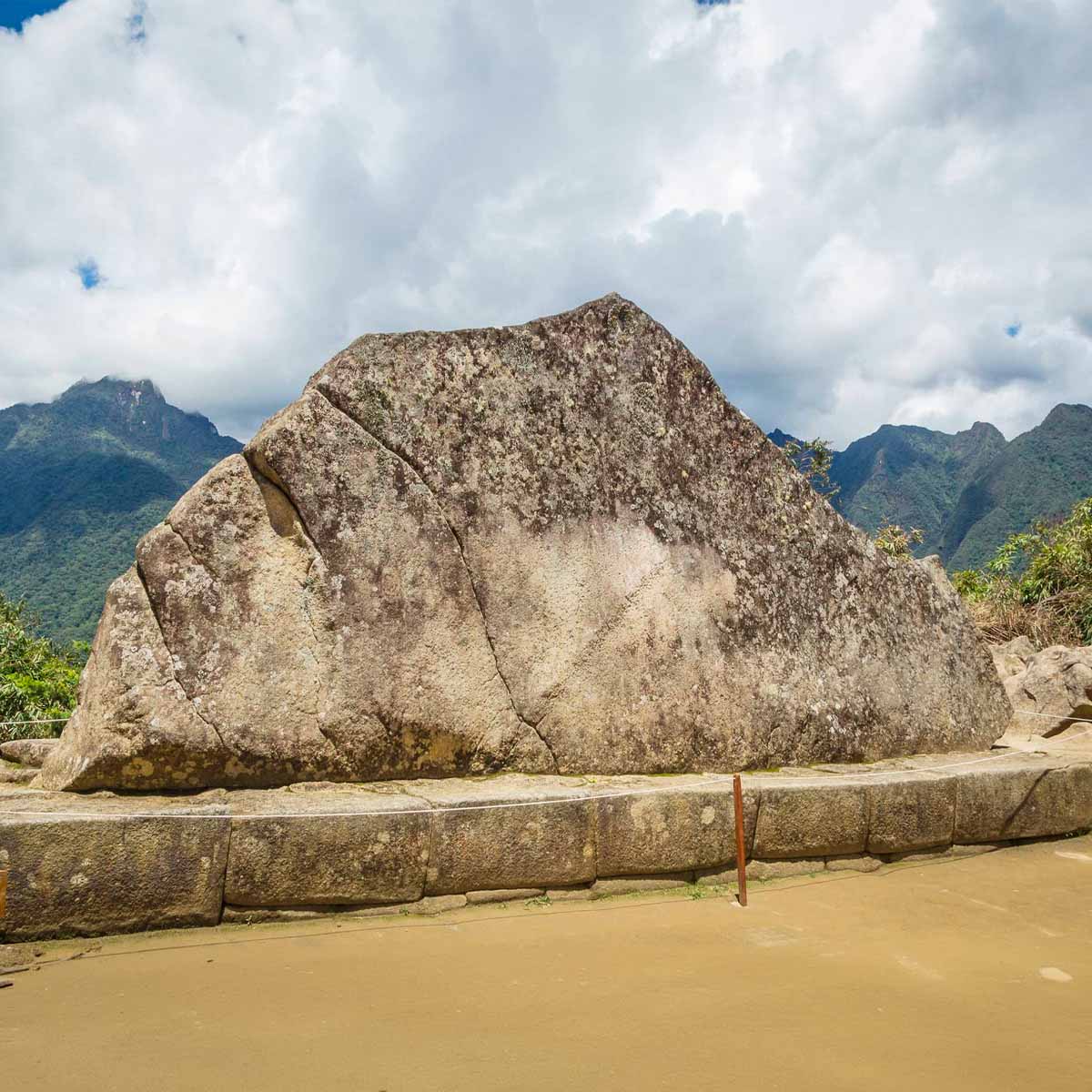
It is a large granite monolith that rises at the northern end of the citadel, near the start of the path to Huayna Picchu. Although it looks like a smooth and vertical rock, its importance lies not in what was built, but in what it represents.
According to the most widespread interpretation, its profile resembles that of the mountain rising behind it, suggesting an intention to reproduce in stone the sacred landscape surrounding it. In the Andean worldview, mountains, or apus, were protective divinities, and several of them surround Machu Picchu.
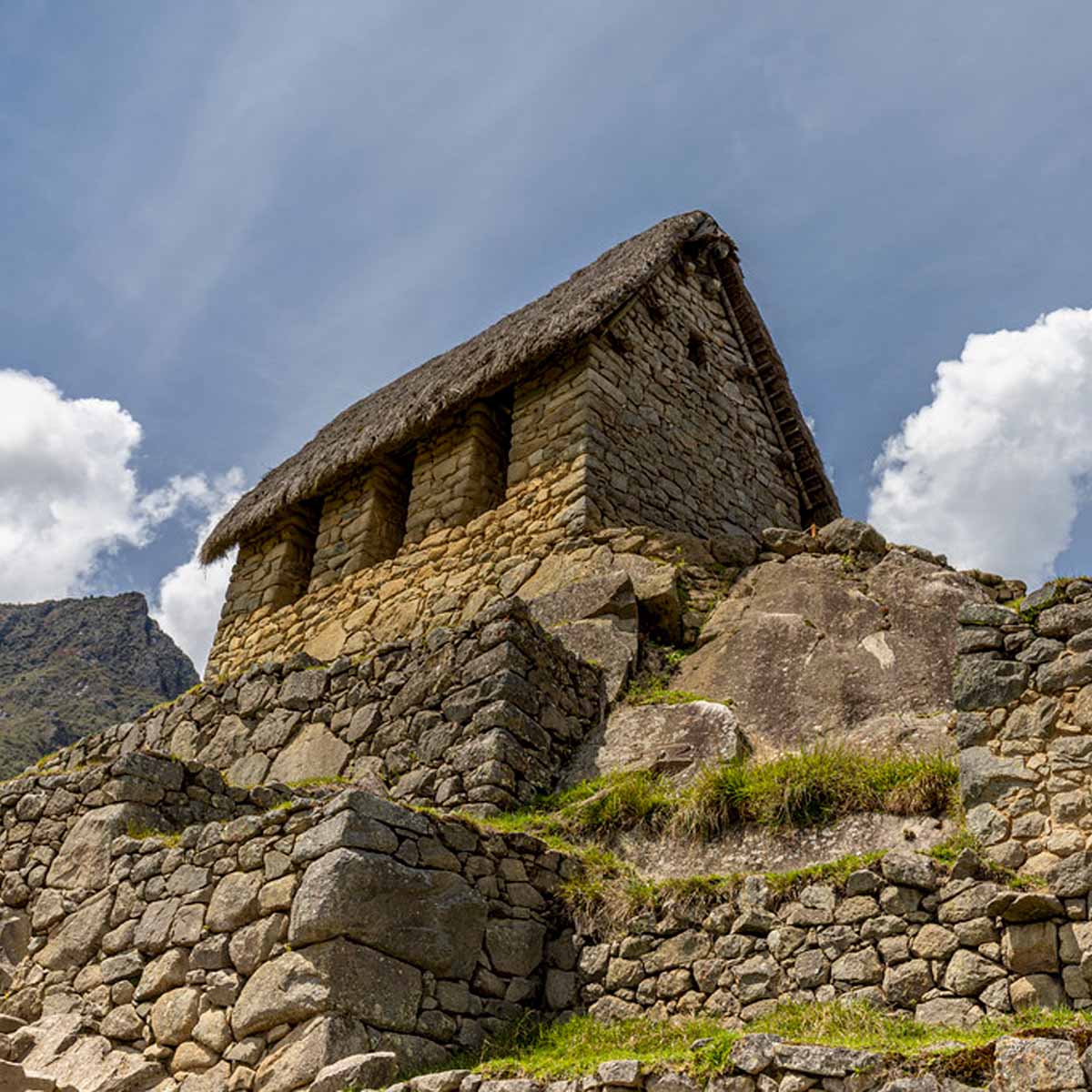
It is located in the upper part of the agricultural sector, above the terraces. It is a simple, three-sided construction with an open front, covered with a reconstructed thatch roof that allows imagining what Inca homes were like.
It is believed to have served to monitor and control accesses to the city, as well as supervise agricultural work. It sits next to other spaces like the quarry and the Funerary Rock, which show the variety of activities in the citadel.
In addition to the seven main spaces, the citadel holds other attractions of Machu Picchu that help understand how the city functioned. Many are crossed during the tour, so here we present them briefly so you know what you are seeing when you pass by them.
Some of the most sought-after attractions of Machu Picchu are not only inside the citadel. Among these places are paths, gates, and mountains that surround the citadel and complete the landscape. Each one is visited with a specific route, so it is convenient to know what it offers before choosing your ticket.
It is the ancient entry gate to Machu Picchu for those arriving via the Inca Trail, and it is located in a mountain pass above the citadel. Inti Punku means "sun gate" in Quechua. From there, an elevated view of the sanctuary is obtained, which is the first one seen by those who finish the Inca Trail. Today it can also be visited as a hike from the citadel.
It is a stretch of the Inca trail that borders a nearly vertical cliffside. To cross a section without support, the builders supported it with stone walls and completed it with wooden logs, which could be removed. Therefore, it is interpreted to have fulfilled a defensive or access control function. The hike to the place is short and flat, but it passes next to a cliff.
It is the mountain that appears behind the citadel in the classic photograph. Its name means "young mountain" in Quechua. The trail climbs steep stone steps and exposed sections, up to a summit with terraces and enclosures showing that it was also built upon. From above, Machu Picchu is seen from a unique perspective.
It is located on the opposite side of Huayna Picchu. It is a natural cavity worked by the Incas, with walls of finely carved stone and niches, so that the rock and the construction form a single space. It is described as a carved ceremonial sanctuary, located on the other side of Huayna Picchu.
They are two hiking destinations, rather than constructions, with views of the sanctuary.
Visiting the citadel is an unrepeatable experience, and a few prior decisions help to enjoy it better and preserve it. These tips will serve you to appreciate each construction calmly:

 +51 84 217 551
 +51 997 434 941
 Av Tupac Amaru PP-10B, Santiago, Cusco, Peru
  info@incatrailmachu.com
 www.incatrailmachu.com


