
To answer the question, How is the climate in Machu Picchu?, it is essential to understand its location. The Inca citadel sits at 2,430 meters above sea level (7,972 feet), in an Andean cloud forest zone (ceja de selva). This location, in the transition from the Andes Mountains to the Amazon, creates a mild and highly humid climate throughout the year.
The climate in Aguas Calientes and Machu Picchu is strictly divided into two seasons that affect the visitor's experience. The dry season (from April to October) offers sunny days and is the best time for visibility and hiking. In contrast, the rainy season (November to March) registers the greatest amount of rainfall and brings with it the challenge of dense fog in the mornings, although temperatures are more stable.
Throughout the year, daytime temperatures remain relatively constant, ranging between 20°C and 25°C. The critical variation occurs at night, which can be freezing in the dry season. This guide will deeply analyze the Climate of Machu Picchu, providing the necessary precipitation and temperature data to plan your trip safely and efficiently.
Machu Picchu is located in a sub-tropical zone, nestled between the Machu Picchu and Huayna Picchu mountains, protected by the snowy Salkantay to the south and the Veronica to the north. This rugged geography gives Machu Picchu a very peculiar climate, fresh and warm, with sunny and rainy days, depending on the time you decide to travel; all this climatic variation makes the Sanctuary of Machu Picchu a wonderful place, with an enormous biodiversity, that inhabits one of the richest ecosystems of the planet.
It is one of the best questions before going to Machu Picchu, and in truth only you can choose when to go to Machu Picchu. The climate in Machu Picchu and Cusco is clearly marked by 2 seasons or seasons; the rainy season and the dry season. Below we detail each of them.
Important: Regardless of which time you come, you must bring waterproof clothing, because regardless of the season, the rains may fall at any time of the year.
The rainy season in Machu Picchu goes from November to March, being the period that records the largest amount of annual rainfall. February is the rainiest month, which is why the Classic Inca Trail closes for maintenance. Daytime temperatures remain warm, ranging between 19°C and 21°C. Unlike the dry season, the nights are milder, since the cloudiness helps to hold the heat. This abundance of rain dresses the Inca city in a deep green.
Rains usually appear in intermittent showers that can last from a few minutes to a couple of hours, and generally happen in the afternoon. However, the main risk during this season is the increase in dense fog that can block visibility in the early morning hours, which harms the panoramic views. Furthermore, the stone stairs and paths become slippery, which demands extra caution.
The Dry Season in Machu Picchu goes from April to October, and it is the most stable period with the lowest chance of rain, making it the most popular for travelers. The days are consistently sunny, with clear skies, which causes a sharp variation in daytime temperature. The average maximum temperatures range between 17°C and 19°C, which allows for a pleasant hike under the sun.
However, this climate stability brings with it the challenge of freezing nights. Due to the lack of cloudiness, the minimum temperatures drop drastically, frequently falling below 0°C (32°F) in the central months of June and July. This is also the high tourism season period, so the flow of visitors is maximum, and booking planning is essential.

The Historic Sanctuary of Machu Picchu remains open throughout the year, which allows visitors in any season. However, weather conditions vary notably month by month. The key to understanding the climate is the duality of the dry season (April to October) and the rainy season (November to March). Daytime temperatures remain constant and mild throughout the 12 months.
The most significant variation occurs in precipitation and in nighttime lows. June and July are the coldest and driest months, offering the best views but the coldest nights. On the other hand, January and February register the highest amount of rain, with the latter being the month with the highest precipitation, which is why the Inca Trail closes annually.
So, here is the climate of Machupicchu by month:
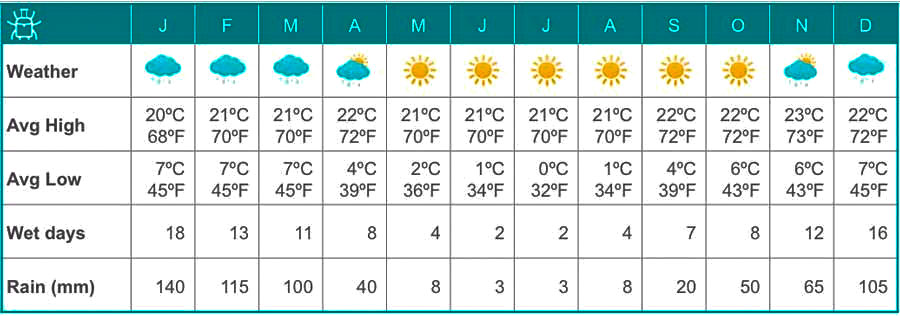
JanuaryRainy seasonUp to 160 mm of precipitation | FebruaryRainy seasonUp to 133 mm of precipitation | MarchEnd of the rainy season
|
April Best travel time to the Inca Trail
| MayBest travel time | JuneBest travel time |
JulyBest travel time
| AugustBest travel timeOptimal climate to the Inca trail | SeptemberBest travel timeOptimal climate to the Inca Trail |
OctoberGood travel time
| NovemberBeginning of the rainy season | DecemberRainy season |
Machu Picchu Temperature by month | ||||
| Parameter | Max. Temperature (°C) | Max. Temperature (°C) | Sunny days/ day | Rainy days/ month |
| January | 19 | 9 | 5 | 18 |
| February | 20 | 10 | 4 | 13 |
| March | 21 | 8 | 6 | 11 |
| April | 21 | 6 | 7 | 8 |
| May | 21 | 3 | 7 | 3 |
| June | 21 | 2 | 8 | 2 |
| July | 21 | 1 | 8 | 2 |
| August | 21 | 3 | 7 | 2 |
| September | 21 | 5 | 6 | 7 |
| October | 21 | 6 | 6 | 8 |
| November | 21 | 7 | 6 | 12 |
| December | 21 | 8 | 5 | 16 |
During your visit to Machu Picchu, you can choose between a variety of tours. These range from a full-day excursion to Inca Trail through the Sacred Valley of the Incas or Machu Picchu tours from Cusco. The multi-day tours can be combined with climbing of the Huayna Picchu mountain or the Rainbow Mountain, a trek through the Andes villages with living traditions. If the classic trail is sold out, the best hiking option is the short Inca Trail, this trail is part of the Inca path. There are also alternative treks to Machu Picchu, such as Salkantay Trek, Lares trek, Inca Quarry or Huchuyqosqo Trek. There are no limits to your thirst for adventure to Machu Picchu!

 +51 84 217 551
 +51 997 434 941
 Av Tupac Amaru PP-10B, Santiago, Cusco, Peru
  info@incatrailmachu.com
 www.incatrailmachu.com


