
On top of the Pukamoqo hill, looking over the northern sector of the city, stands the Cristo Blanco (White Christ), an impressive 8-meter-tall statue. Its location is very close to the Sacsayhuaman fortress. This viewpoint has become an essential stop within any Cusco City Tour and Ruins, offering the most complete panoramic view of the Inca capital and the valley.
Unlike the monuments, the White Christ is a modern addition, donated to the city in 1945 by the Palestinian Arab colony. It was intentionally erected on the Pukamoqo hill, a place that was already considered a spiritual site by the Inca civilization. This contrast between the Catholic symbol and the ancient Andean sacredness is a characteristic feature of Cusco's cultural heritage.
Although most visitors admire the statue and enjoy the views, few know the details behind its construction and its meaning as a symbol of protection.
Did you know its history? Now we tell you.
The white Christ is a beautiful white statue located on the Pukamoqo hill, donated by the Palestinian Arabs who migrated to this part of Peru as a refuge after the Second World War. The appearance of the effigy is very similar to the Christ the Redeemer of Rio de Janeiro in Brazil, like this with his arms outstretched in the air. This is a much smaller version but it also retains its own charm.
Also, according to Inca legends, it is known that the "Puka Moqo" hill, where the statue is located, was a place dedicated to spirituality. This urban myth refers to the ground that you step on when you arrive at this tourist attraction, contains samples of the four suyos of the Inca Empire, we are talking about the Tahuantinsuyo.
The amazing statue of the White Christ was made by the famous Cusco artist Francisco Olazo Allende. He had the important help of craftspeople from the traditional San Blas neighborhood. The first stone was placed on June 24, 1944. This was the same day as the first celebration of Inti Raymi (Festival of the Sun). Thanks to the hard work of the artist and the people of Cusco, the big sculpture was finished and delivered in 1945.
This famous figure is 8 meters tall and bright white. It is made with a metal frame covered in granite, marble, and plaster. It shows Jesus Christ with his arms open. This is a symbolic gesture of welcome and protection for the city of Cusco. For local people, the White Christ is much more than a piece of art: it represents peace, blessing, and divine protection for the Catholic community in the area. This fantastic tourist destination is a must stop for tourists arriving for the first time in Cusco, there is no entrance fee and being on a high site, it is considered a strategic viewpoint.
The Cristo Blanco monument is located just 2 kilometers on foot from the city of Cusco, a few steps from the entrance gate to the archaeological site of Sacsayhuaman. Geographically it is located at 3,575 meters above sea level.
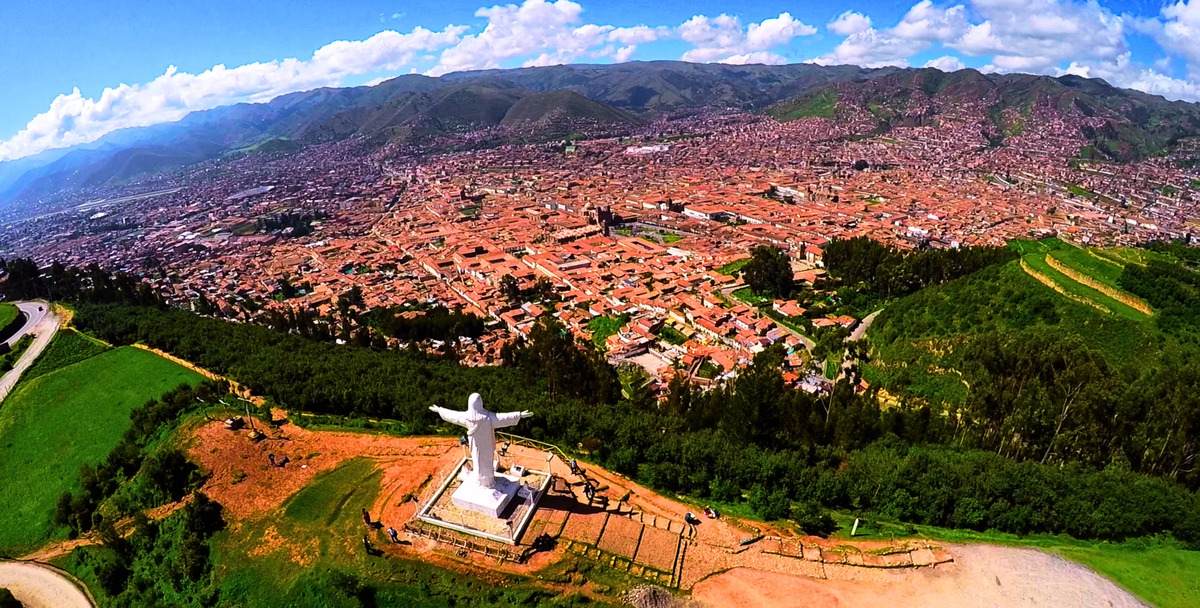
Statue of Jesus Christ in Cusco
From the center of the city of Cusco, we can choose to reach the White Christ in 3 ways:
You ask yourself: What is the cost to enter this place? Then you should know that access to the viewpoint and the Cristo Blanco statue is completely free. Unlike the neighboring Sacsayhuaman fortress and other archaeological sites on the ruins circuit, this statue does not require the purchase of the Cusco Tourist Ticket.
This being free means that the cost of the visit is exclusively limited to the means of transport chosen to go up the Pukamoqo hill. The main goal of the place is to serve as a viewpoint of the city, offering a panoramic view that lets you appreciate the urban design of Cusco and the layout of its historic center and the surrounding valleys.
The Sacsayhuaman Fortress or “Saqsaywaman” is an Inca archaeological site whose construction dates back to the 15th century. It is one of the most incredible Inca empire buildings in the world. This Inca architectural achievement represents a magnificent building since it is the most extensive ceremonial center built by the Incas during their empire.
Qenqo is the name of the Inca archaeological center located on the outskirts of the city of Cusco. This archaeological site is famous for its underground tunnels. According to history, it is said that Qenqo was an Inca site where religious ceremonies were held. In addition, it is also known as the forest of Qenqo.
Puca Pucara is an old Inca military construction located in the city of Cusco. This fortress is made up of large walls, terraces and stairways. In Puca Pucara you will be able to appreciate different constructions, among them are: squares, enclosures, bathrooms, terraces. The constructions of this complex are characterized by being made of limestone.
Tambomachay, is one of the most important archaeological sites in the city of Cusco. Formerly, this place was known as the "Inca spa". The main function of this archaeological complex was to provide water to the nearby archaeological sites and also served as a resting place for the Inca ruler, right there is the main waterfall known as "the baths of the Inca", which until today its waters flow completely normal.
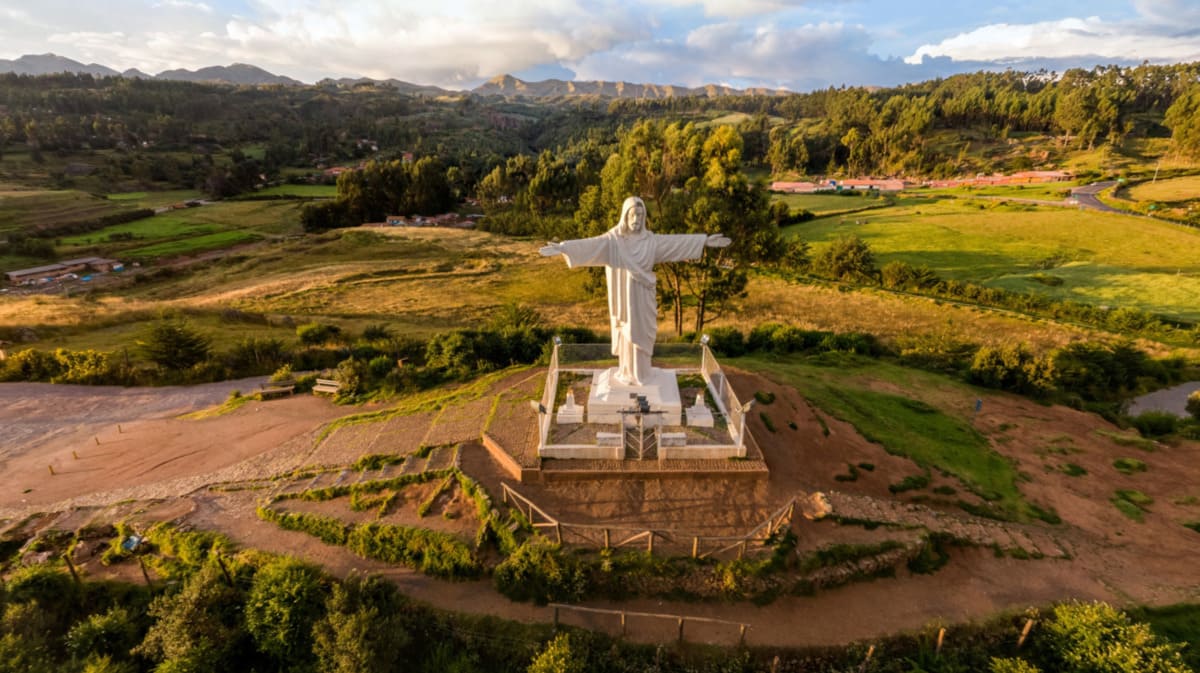
White Christ Cusco
Peru offers fascinating experiences that reveal natural landscapes, historical monuments, and living cultures, captivating those who seek adventure and discovery in every corner of its territory. Get to know the most outstanding tours:
Other trips in Peru
If you want to visit Machu Picchu, we recommend you to book your Machu Picchu Entrance Tickets in advance, so you will enjoy your Vacation in Machu Picchu without any problem.

 +51 84 217 551
 +51 997 434 941
 Av Tupac Amaru PP-10B, Santiago, Cusco, Peru
  info@incatrailmachu.com
 www.incatrailmachu.com


